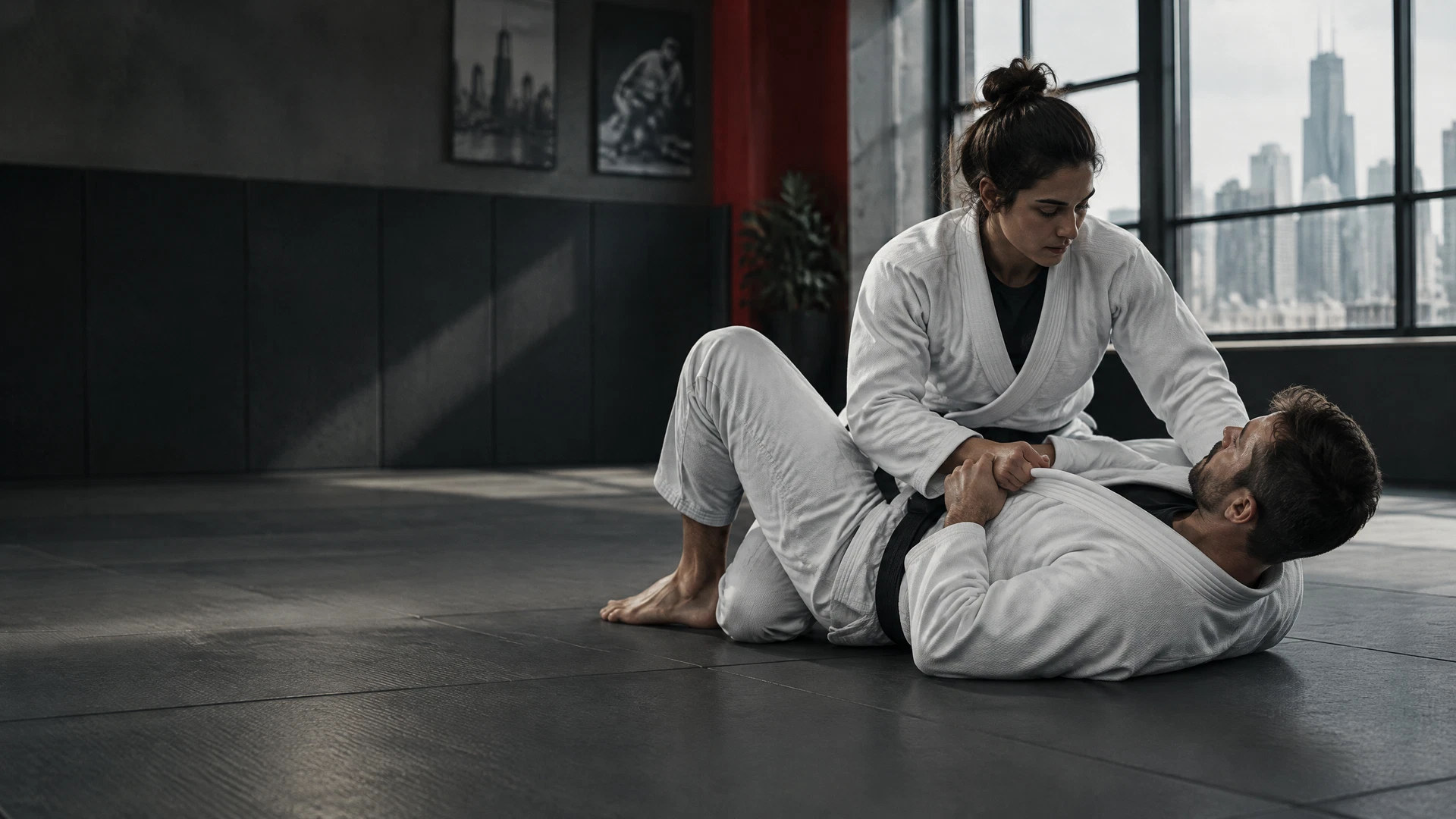
Brazilian Jiu-Jitsu is a ground-focused grappling art. Students can learn how position, posture, leverage, and timing shape an exchange before they worry about moving quickly.
Every class gives you a clear place to begin, with coaching feedback and attentive repetitions that help you build one skill at a time.
01
Build a positional map
BJJ gives names and priorities to the places an exchange can travel, helping students study how common positions connect and why each changes the next decision.
Guard, mount, side control, and back control
Posture, base, and balance
Creating or recovering control
02
Use leverage before force
Technical drills can help students recognize frames, hooks, angles, and weight distribution as practical tools for creating room or applying pressure.
Framing and hip movement
Connection and weight placement
Timing a transition
03
Develop defensive options
Escapes are studied as active technical problems. Students may explore how to protect posture, create space, turn to a safer position, and reconnect to a guard or standing base.
Mount and side-control escapes
Guard retention concepts
Defensive posture and recovery
04
Train the submission context
Chokes and joint locks are studied as part of a positional sequence, with coaching and partner communication guiding the pace of the work.
Submission awareness
Tap early and release promptly
Partner-controlled practice
The tradition
Know where the art comes from.
Brazilian Jiu-Jitsu developed in Brazil through the twentieth-century evolution of jujitsu and ground-fighting practice. Its modern visibility grew alongside Brazilian vale tudo and later mixed martial arts, while sport formats center on positional work and submissions.
Understanding an art’s history gives useful context for the technical work you will see on the mats.
The program
How training takes shape.
Brazilian Jiu-Jitsu is a grappling practice built around distance, clinch work, takedowns, positional control, escapes, and submissions. Chicago MMA presents it through the Ralph Gracie Brazilian Jiu-Jitsu lineage while keeping the day-to-day focus on careful technique and training partners.
A typical session moves from movement preparation into a focused technical problem, then toward coached practice at an intensity matched to the room.
01
Prepare
Movement and positional preparation set the session’s theme.
02
Learn & drill
A technique is introduced, then repeated with a partner in a cooperative drill.
03
Apply with control
Positional rounds or rolling can connect the skill to live decision-making.
Classes follow a focused format built around the day’s technical theme. Review the weekly schedule for current times, then ask the team about the class you plan to attend.
Your foundation
Skills that add up.
Students may study how positions connect, how leverage and timing affect control, and how to respond when an exchange changes.
Coaches introduce skills in clear steps and help students identify a productive next focus for their own training.
01
Position & control
Study guard, mount, side control, back control, and the choices that help create or recover position.
02
Escapes & transitions
Work on frames, movement, balance, and transitions that connect defensive and offensive positions.
03
Submission awareness
Learn the mechanics and responsible training context for common joint locks and chokeholds.
Chicago MMA team
People in the roster.
Meet the coaches connected to this training path. Use the weekly schedule or contact Chicago MMA for the latest class information.
The practice gives students repeated opportunities to work on positional awareness, movement, timing, and technical problem-solving with training partners. Research describing BJJ competition also characterizes the sport as an intermittent grappling activity with meaningful strength, mobility, and conditioning demands.
Consistency, attention, and good training partners give you more opportunities to understand the art over time.